|
|
|
| |
 |
|
|
|
 推薦指數:
推薦指數:

|
|
- 內容介紹
|
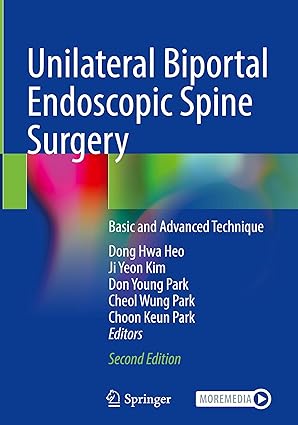
Unilateral Biportal Endoscopic Spine Surgery: Basic and Advanced Technique Second Edition 2025
by Dong Hwa Heo (Editor), Ji Yeon Kim (Editor), Don Young Park (Editor), Cheol Wung Park (Editor)
Publisher : Springer
Edition : Second Edition 2025
Language : English
Print length : 489 pages
ISBN-10 : 9819670217
ISBN-13 : 978-9819670215
Item Weight : 2.68 pounds
2025
As of recent years, biportal endoscopic spine surgery has gained significant attention and adoption in the field of spine surgery due to its minimally invasive nature and the advantages it offers. This technique is increasingly popular among spine surgeons for treating various spinal disorders, such as herniated discs, spinal stenosis, and spondylolisthesis. Its minimally invasive approach allows for smaller incisions, less muscle disruption, reduced postoperative pain, and quicker recovery times compared to traditional open surgery. Numerous studies have reported favorable outcomes with biportal endoscopic spine surgery, including reduced operation times, lower complication rates, and improved patient satisfaction. These outcomes contribute to its rising adoption. Continuous innovation is likely to further establish biportal endoscopic surgery as a standard practice for suitable spinal conditions. It would introduce the fundamental concepts of endoscopic anatomy, and the basics of endoscopic equipment and techniques. Detailed descriptions of biportal endoscopic procedures would be included, showcasing step-by-step surgical methods, including setup, entry points, and the use of instruments. The book will explain the indications, contraindications, clinical applications of biportal endoscopic spine surgery, and potential complications. Updates on the latest advancements in technology, techniques, and clinical research findings will be covered to keep practitioners up-to-date. In summary, biportal endoscopic spine surgery is becoming a significant part of modern spine surgery practices due to its minimally invasive nature, positive clinical outcomes, and the ongoing development of surgical techniques and equipment.
|
|
|



 其他相關書藉
 [
[  [
[